
Product Page SEO: 12 Tactics to Rank and Convert in 2026
Let's be honest about something most SEO guides won't say upfront: the majority of product pages on the internet are mediocre. They have a product name, a manufacturer description copied from a spreadsheet, three images shot in a warehouse, and a price. That's it.
And somehow, people are surprised when those pages don't rank.
In 2026, Google's bar has risen significantly. AI Overviews now pull structured answers directly from product pages. The pages that show up are the ones that are genuinely useful — not just the ones with the most backlinks. That's actually good news if you're willing to do the work. This guide covers 12 tactics that have moved rankings and revenue for real stores. Whether you're approaching ecommerce product page SEO for the first time or trying to close the gap between where your pages rank and where they should, these apply. Let's get into it.
01. Title Tag Architecture That Ranks and Gets Clicked
Your title tag is doing two jobs at once: convincing Google your page is relevant, and convincing the searcher to click instead of the ten other results on the page. Most product pages fail at the second job.
The typical ecommerce title looks like this: "Blue Running Shoes — BrandName." That's a product name, not a title tag. It doesn't tell Google what problem you solve, and it gives the searcher no reason to choose you over the competition.
What actually works is a formula that front-loads your primary keyword, adds a differentiating feature, and ends with your brand:
In practice: "Waterproof Trail Running Shoes for Men | Lightweight & Grip-Tested | TrailPro." That title ranks for the keyword and gives someone scrolling the SERPs a genuine reason to click.
One note for Shopify stores — Shopify product page SEO starts here, and the platform will auto-generate title tags from your product name if you let it. Don't. Go into the SEO section of each product and write a custom title. The lift is immediate and costs nothing. For product variants on separate URLs: give each one a genuinely different title. "Red Running Shoes" and "Blue Running Shoes" are thin and Google will likely only rank one. "Men's Trail Running Shoes in Red — Breathable Mesh, Sizes 8–14" is a real title.
02. Product Schema Markup for Rich Results and AI Visibility
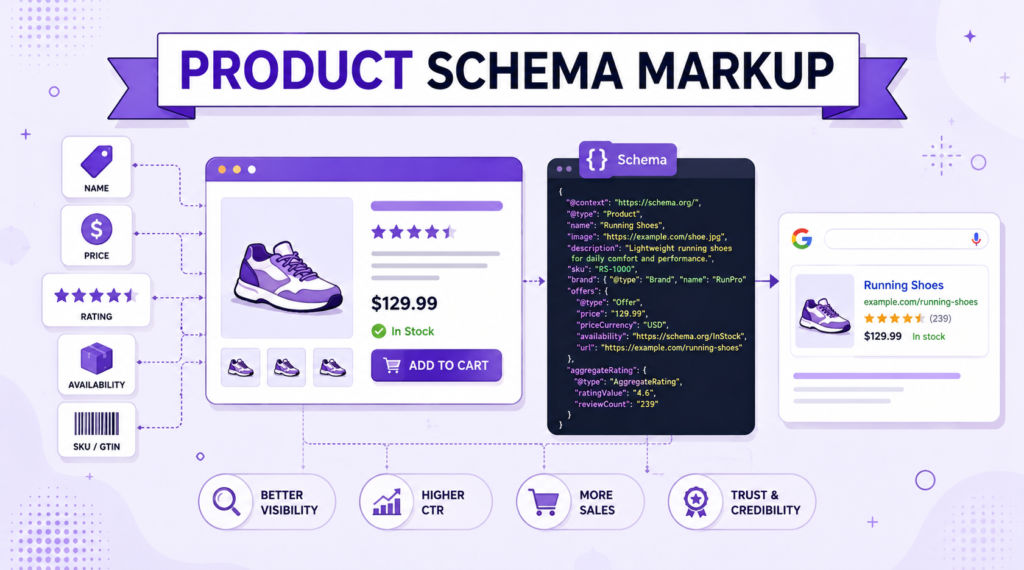
If you're not using schema markup on your product pages, you're essentially asking Google to guess at your content structure. In 2026, that guessing has real consequences.
Ecommerce schema markup is what turns your page into a rich result — the listing with the star rating, price, and shipping info visible before anyone even clicks. It's also what gets your product pulled into Google AI Overviews. Without it, you're just text.
Here are the schema types every product page should have:
| Schema Type | What It Gets You | Priority |
|---|---|---|
| Product | Name, price, SKU, brand, availability in SERPs | Critical |
| AggregateRating | Star ratings visible in search results | Critical |
| Offer | Price, shipping time, return policy in results | High |
| FAQPage | Your Q&As pulled directly into AI Overviews | High |
| Review | Individual review snippets in rich results | High |
| BreadcrumbList | Navigation path shown in search results | Medium |
💡 Quick tip After implementing schema, run it through Google's Rich Results Test. If you see errors, Google is almost certainly ignoring your markup entirely. For large catalogs, a good ecommerce development company can automate schema generation through Liquid templates on Shopify or a custom backend on other platforms — rather than managing it product by product.
03. Image SEO That Drives Real Traffic
Here's a question: how many of your product images are named something like IMG_4392.jpg? If the answer is "most of them," you're leaving a meaningful traffic source completely untouched.
Google Images drives billions of visits to product pages every month. Most stores capture almost none of that because their images have no readable file names, no alt text, and no connection to their product schema.
Fixing this is straightforward:
- Rename image files descriptively before uploading — "mens-waterproof-trail-shoe-red.jpg", not "product-1.jpg"
- Write alt text that describes the image clearly and naturally — "Men's red waterproof trail running shoe with grip outsole"
- Convert to WebP format where possible — it's 25–35% smaller than JPEG at the same visual quality, which directly improves your Core Web Vitals score
- Reference your image URLs in your Product schema — this makes them eligible for Google Shopping image results
On product pages with richer image galleries, the gains can be significant. A skincare brand that worked with an ecommerce optimization services team added contextual lifestyle images to 200 product pages and saw a 22% increase in organic sessions within 60 days — not from adding keywords, but from images telling a better story.
04. Page Speed as a Ranking and Revenue Asset
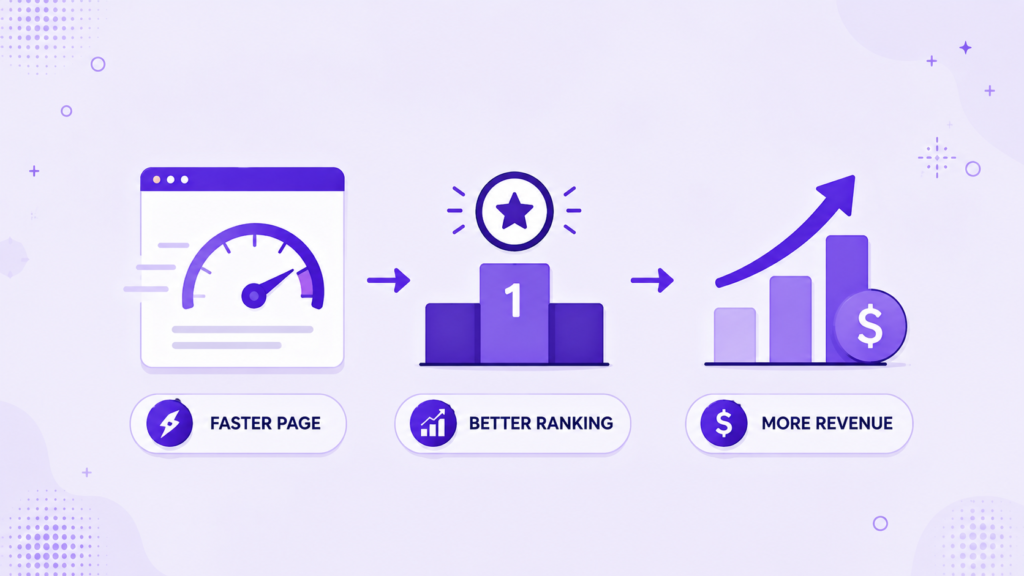
Amazon found that every 100ms of additional load time cost them 1% in sales. For a store doing $1M annually, a 2-second slowdown could mean $200,000 in lost revenue every year.
Page speed is a confirmed Google ranking signal through Core Web Vitals. But the revenue math above is the more compelling argument. Speed is the rare optimization where the ranking benefit and the conversion benefit point in exactly the same direction.
The three metrics that matter most for product pages:
- LCP (Largest Contentful Paint): How long until the main product image loads. Should be under 2.5 seconds. Fix it by preloading the hero image and serving it through a CDN.
- INP (Interaction to Next Paint): How fast the page responds when someone taps your add-to-cart button. Under 200ms is the target. JavaScript-heavy pages with lots of third-party apps often struggle here.
CLS (Cumulative Layout Shift): How much the page jumps around as it loads. Unexpected layout shifts destroy mobile UX and trigger early exits. Reserve space for every image and late-loading element.
💡 Quick tip On Shopify, the biggest speed killers are usually third-party apps loading unnecessary scripts. This sits squarely in ecommerce technical SEO territory — even apps you're not actively using can run in the background and slow things down. Audit your app stack with GTmetrix or WebPageTest before touching anything else.
05. Product Page UX That Keeps Buyers Engaged
Google doesn't just look at your page — it watches what people do after clicking from search results. Someone who lands on your product page, spends 3 minutes reading details, scrolls through the reviews, and adds to cart is sending a very different signal than someone who bounces in 9 seconds.
Good UX is an indirect but real SEO input — and it's also the foundation of ecommerce conversion optimization. A few specific things move both metrics at the same time:
- Sticky add-to-cart button. The CTA should follow the user as they scroll. Removing the need to scroll back up reduces friction in a measurable way.
- Tabbed content. Specs, care instructions, FAQs, and reviews in clean tabs prevent content overload while keeping everything accessible.
- Inventory signals. "Only 4 left" or "Ships in 2–3 business days" are honest nudges that reduce hesitation without being manipulative.
- Related products. Keeps buyers on-site when the current product isn't quite right — better for session depth and for SEO.
- Above-the-fold essentials. Product name, price, a star rating, and the CTA should all be visible without scrolling on mobile. Every extra scroll before the CTA costs you conversions.
💡 Quick tip Session recording tools like Hotjar or Microsoft Clarity reveal exactly where users drop off. A 30-minute review often surfaces UX fixes that have a faster revenue impact than any ranking change.
06. Mobile-First Optimization Done Right

Google has indexed the mobile version of websites first since 2019. That means when Google evaluates your product pages, it's evaluating the mobile experience — the desktop version is almost secondary.
Yet most stores still build desktop-first and hope it translates. It usually doesn't. Here's a quick audit you can run on your own product pages right now:
- Tap targets (buttons, links) are at least 48×48 CSS pixels — small size selectors are the most common failure
- Product images can be swiped with a finger, not just clicked with arrows
- Body text is at least 16px — anything smaller requires pinching to read
- The add-to-cart button is visible on the first screen without scrolling
- Pages load in under 3 seconds on a mid-range Android device (not just iPhone)
- No horizontal scroll or content overflow on narrow screens
- Images can be pinch-zoomed to see product detail
These aren't design preferences — they're baseline requirements for Google to rank your pages competitively and for mobile visitors to actually buy. If you're working with an ecommerce development company on a new build or redesign, make sure mobile product page performance is explicitly scoped into the project, not assumed.
07. Reviews as an SEO and Trust Signal
Reviews are doing three separate jobs on your product pages, and most brands only think about one of them.
Obviously, reviews build trust and lift conversions. A product page with 47 reviews and a 4.6 rating will outperform an identical page with no reviews, every time. But there's more going on:
Reviews generate fresh, unique content. Google rewards pages that get updated regularly, and a product page where reviews accumulate is technically getting new content added to it constantly. That freshness signal is real.
And with AggregateRating schema, your star ratings show up directly in search results — which drives noticeably higher click-through rates from the SERP.
Reviews should be a deliberate part of your ecommerce SEO strategy, not something that happens by accident. The most sustainable approach has four components:
- Automated post-purchase emails at 7–14 days after delivery, when buyers have actually used the product
- A small incentive for photo reviews — they improve conversion rates and create image content Google can index
- Responding to all reviews, including negative ones — brand responses signal active engagement
- Syndicating from Google Shopping, Trustpilot, or other platforms to build volume faster on new products
Pages with AggregateRating schema and at least 10 reviews are significantly more likely to appear in Google AI Overview product recommendations. In 2026, that's the new featured snippet for ecommerce.
08. Content Depth That Satisfies Search Intent
There are still thousands of product pages out there with 40-word manufacturer descriptions that haven't been touched since the product was added to the catalog. Those pages do not rank. Google has no idea what to do with them.
In 2026, Google's content evaluation goes well beyond keywords. Effective product page optimization means covering your topic with enough depth to be genuinely useful — your content should answer the questions a real buyer would have before purchasing.
That doesn't mean writing a 2,000-word essay on every product. It means writing content that's actually for a human:
- 150–300 words of original copy, written in buyer language, not catalog language. "Perfect for trail runs over technical terrain" beats "Suitable for outdoor use" every time.
- Structured specs in a table — dimensions, materials, compatibility, care instructions. These reduce pre-purchase questions and satisfy informational intent in one shot.
- An FAQ section answering the 5–7 questions buyers actually have. Mark it up with FAQPage schema and those answers become candidates for AI Overview citations.
- A short product video if you have one. A 60–90 second demo increases time-on-page measurably. Add VideoObject schema for additional SERP visibility.
09. Internal Linking Strategy for Product Pages
Here's a scenario that plays out constantly: a store publishes a buying guide that ranks well, gets good traffic, and earns backlinks. But the buying guide barely links to actual product pages. All that authority sits in the blog, and the products — which are what actually make money — get almost none of it.
Internal links pass authority. They also create multiple pathways for Google to discover and recrawl your most important pages. Product pages that only receive links from a category page are significantly underserved.
| Link Source | Link Target | Anchor Text Approach |
|---|---|---|
| Blog post ("Best trail shoes for beginners") | Product page | Exact or partial match keyword |
| Category / Collection page | Product page | Product name with key feature |
| Buying guide | Multiple product pages | Descriptive contextual anchors |
| Related products widget | Adjacent products | Product name |
| Homepage featured section | Top product pages | Category keyword or brand term |
A quick win worth doing right now: crawl your site (Screaming Frog has a free tier) and find every product page with fewer than 3 internal links pointing to it. Those are your authority-starved pages. A few targeted links from existing high-traffic posts can move rankings within 60–90 days. This is also one of the first things a good ecommerce SEO services team will flag in an initial audit.
10. Optimizing for AI Overviews and Generative Search
Google AI Overviews are now appearing on a meaningful percentage of commercial searches — especially for product research queries like "best running shoes for flat feet" or "is [product] worth it." The stores that show up in those overviews are capturing clicks that never even reach the organic results below.
The pages that get cited share consistent characteristics. It's not magic — it's structure:
- Direct, factual answers appear early in the content, not buried after three paragraphs of brand storytelling
- FAQ sections with concise answers — under 60 words per answer is the sweet spot for AI extraction
- Product specs presented in a clean table or bullet list, not buried in paragraph form
- Complete Product schema — incomplete schema means an incomplete representation of your product in AI results
- E-E-A-T signals — author credentials, brand trust markers, and clear sourcing all improve the likelihood of being cited
Think of AI Overview optimization the way you once thought about featured snippets. Early movers got outsized traffic. That window is open right now — and the stores working with an ecommerce SEO agency on this are already building a structural advantage that's very hard for later movers to close.
11. Technical SEO Audit Checklist for Product Pages
Technical issues are quiet. They don't cause obvious problems — they just create a ceiling on how well your pages can rank, no matter how good your content or backlinks are.
Here's what to check on every product page:
| What to Check | What to Look For | Why It Matters |
|---|---|---|
| Canonical tags | Self-referencing canonical on every product URL | Prevents duplicate content from filter and parameter URLs |
| Noindex tags | Confirm product pages are not accidentally noindexed | Common after Shopify theme changes — easy to miss, costly |
| URL structure | Clean URLs without session IDs or excessive parameters | Crawlability and user trust both suffer from messy URLs |
| Schema validation | Rich Results Test shows zero errors | Broken schema earns no rich results — period |
| Out-of-stock pages | 404s redirected or pages kept live with notification | A 404 destroys link equity built to that URL over time |
| XML sitemap | Active products included; discontinued excluded | Guides Google's crawl budget to pages that actually matter |
Running this manually across hundreds of products isn't realistic. Tools like Screaming Frog, Sitebulb, or a Search Console export surface most of these automatically. Most ecommerce SEO experts will have a crawl setup that catches these in the first week. The audit is only useful if it leads to a prioritized fix list — not just a report.
12. Synchronizing SEO and CRO for Maximum Revenue
This is the one most brands get wrong in a structural way. SEO and conversion rate optimization (CRO) end up owned by different people with different goals and different metrics. The result is a product page that ranks but doesn't convert, or converts well but ranks poorly.
The thing is, the best product page work serves both at the same time. The separation is artificial:
- Content depth. Detailed descriptions satisfy Google's quality signals AND reduce buyer hesitation. One piece of work, two benefits.
- Reviews. AggregateRating schema improves your SERP appearance and CTR. The review content closes sales. Same asset, dual purpose.
- Page speed. Faster pages rank better and convert better. The most pure dual-benefit optimization in ecommerce.
- Mobile UX. Google ranks your mobile version. Your mobile visitors are your highest-intent buyers. Improving it is never just an SEO move.
- FAQ sections. They answer presale questions and qualify your page for FAQPage rich results and AI Overview citations simultaneously.
The brands winning in organic ecommerce in 2026 have stopped thinking about their product pages as an SEO project or a CRO project. They treat them as revenue infrastructure. If you want to accelerate that shift across a large catalog, an ecommerce consulting services partner can compress months of trial and error into a focused engagement — but the framing itself is something any team can adopt today.
Common Mistakes to Fix Right Now
Duplicate title tags across variants
If your blue, red, and green versions of a shoe all share the same title tag, Google sees duplicate content and typically only ranks one. Each URL needs a unique, meaningfully different title.
Using the manufacturer's product description
If you source products from a supplier, there's a strong chance 200 other retailers are using the exact same description. Google can't differentiate, so it picks one and ignores the rest. Write original copy — even 150 unique words makes a difference.
Orphaned product pages
A product page with no internal links except from the navigation will always rank below its potential. Link to it from blog posts, buying guides, and collection pages with relevant anchor text.
Returning 404s on out-of-stock products
Any external link pointing to that URL is now pointing to a dead end. Keep the page live with a back-in-stock notification, redirect to the closest alternative, or use a proper soft-404 if the product is permanently gone.
Broken or missing schema
Schema with validation errors does nothing. Google ignores it entirely. Run the Rich Results Test after every implementation and after every major site update. It takes two minutes and catches problems that could otherwise go undetected for months.
FAQ
How long does product page SEO take to show results?
Title tag updates, schema implementation, and internal linking changes typically show measurable ranking movement within 4–12 weeks on pages Google is actively crawling. Page speed improvements can surface faster. Content depth improvements for thin pages take longer — often 3–6 months — because Google needs to re-evaluate the page quality after the changes.
Do I need an agency to do this?
Not necessarily. Many of these tactics can be implemented in-house. Where outside help earns its cost is at scale — hundreds or thousands of product pages, complex technical implementations, or highly competitive categories where moving from position 5 to position 1 has a clear revenue value. For smaller catalogs, a focused in-house effort using a guide like this one is usually the right place to start.
What's the difference between product page SEO and CRO?
SEO gets people to the page; CRO turns them into buyers. In practice, the best product page work serves both. Schema markup improves click-through rates and builds buyer confidence. Content depth helps Google evaluate relevance and answers buyer questions. The division is mostly organizational — the work itself overlaps significantly.
What schema markup is actually required?
The non-negotiables are Product (with name, price, SKU, brand, and availability), AggregateRating if you have reviews, and Offer for pricing details. FAQPage is particularly high-value in 2026 because it's the primary schema type used for AI Overview citations. BreadcrumbList is easy to add and improves how your URL appears in search results.
Wrapping Up
None of this is particularly secret. The tactics in this guide are documented, publicly known, and available to every ecommerce store on the internet. The difference between the stores at position 1 and everyone else is almost always execution — doing the work consistently, across the whole catalog, not just a handful of hero SKUs.
Start with your biggest gap. If your title tags are still auto-generated product names, fix those first — it's fast and the lift is immediate. If you have no schema, that's your priority. If you have schema but it's broken, fix it.
Work through the list. Build it into your operations so new products launch correctly instead of requiring retroactive fixes. Revisit your product pages quarterly. The compounding effect of doing this consistently — more schema coverage, more content depth, more internal links — shows up in rankings and revenue over months, not days.
Your competitors are working on this. The question isn't whether product page SEO matters in 2026. The question is how far ahead you're going to let them get.
