
B2B eCommerce Development: Building a Store for Business Buyers (2026 Edition)
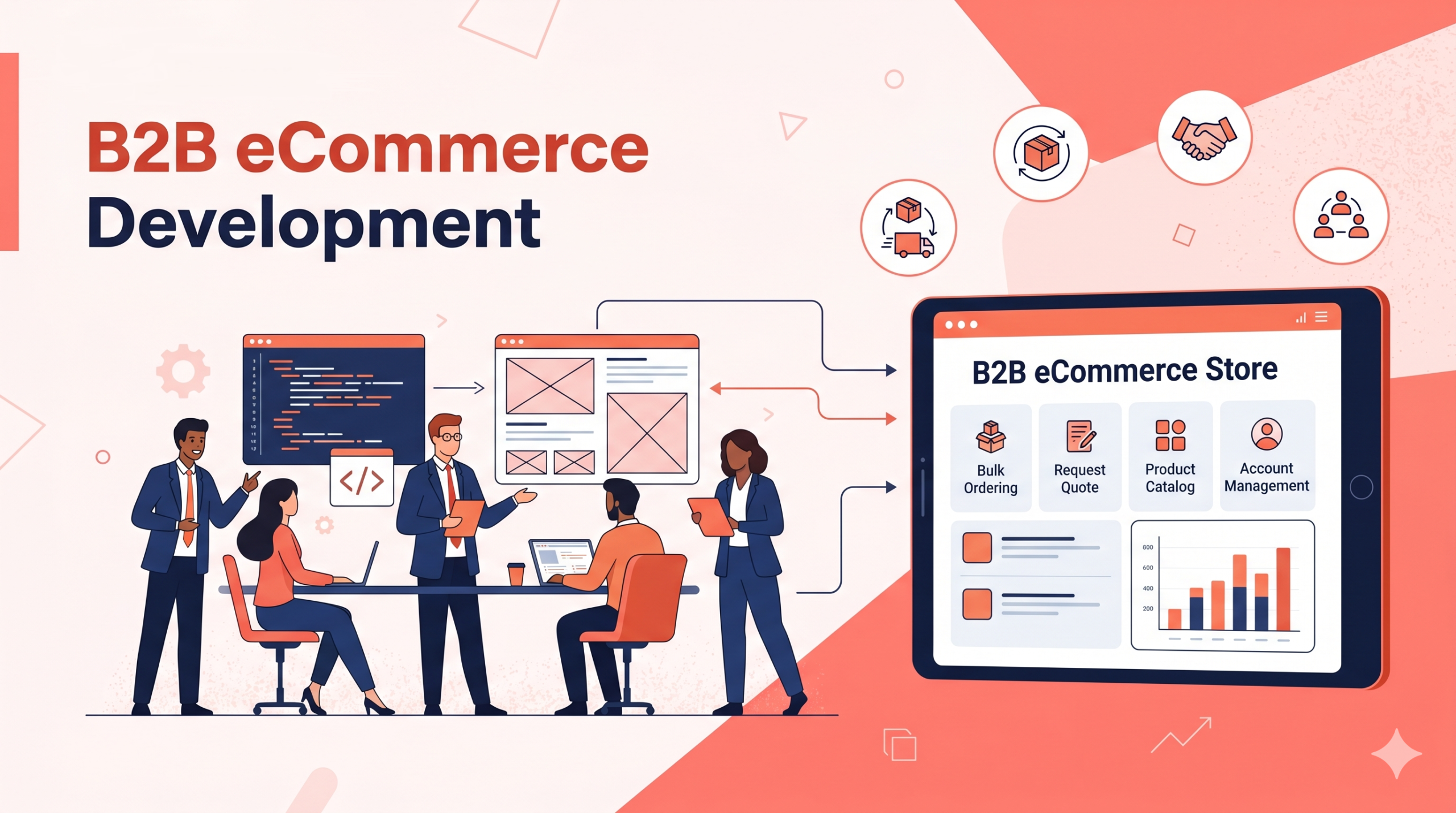
Here's a reality most B2B companies are slow to accept: your buyers are no longer waiting on hold for a sales rep, flipping through printed catalogs, or emailing Excel spreadsheets to place orders.
They're expecting the same seamless, self-service buying experience they get on Amazon — but built for business purchasing. And if your company can't deliver that? They'll find a competitor who can.
B2B ecommerce has quietly become one of the most explosive sectors in digital commerce. According to Forrester Research, the U.S. B2B ecommerce market is projected to exceed $3 trillion by 2027.
According to McKinsey, over 65% of B2B companies now offer ecommerce capabilities — a number that has doubled since 2019. And yet, a huge number of manufacturers, wholesalers, and distributors are still processing orders manually, running outdated portals, or relying entirely on direct sales teams.
That gap — between what buyers expect and what most B2B companies offer — is exactly where smart businesses are winning right now.
This guide covers everything: what B2B ecommerce development entails, which platforms to consider, which features matter most, and how to choose the right ecommerce development company to bring your vision to life.
What Is B2B Ecommerce Development?
B2B ecommerce development is the process of designing, building, and launching an online store or digital ordering system specifically for business-to-business transactions, where the buyer is a company rather than an individual consumer.
Unlike a standard ecommerce website, a B2B ecommerce website needs to handle:
- Bulk and tiered orders with variable pricing
- Multiple buyers under one corporate account
- Net 30/60/90 payment terms instead of immediate checkout
- Custom catalogs that show different products to different customers
- Approval workflows where a manager must sign off before an order finalizes
- Deep integrations with ERP, CRM, and inventory management systems
B2B ecommerce development is a significantly more complex undertaking than building a standard online shop. It requires a different technical architecture, a different UX mindset, and usually a much deeper level of customization.
B2B vs B2C Ecommerce: The Core Differences
| Dimension | B2C Ecommerce | B2B Ecommerce |
|---|---|---|
| Buyer | Individual consumer | Purchasing manager / procurement team |
| Order size | Small, single items | Large, bulk quantities |
| Pricing | Fixed, public pricing | Custom, tiered, negotiated pricing |
| Payment | Credit/debit card at checkout | Net terms, PO-based, invoicing |
| Decision process | Impulse or short research cycle | Multi-stakeholder, long sales cycle |
| Account type | Single user | Multi-user, role-based access |
| Reordering | Occasional | Frequent, scheduled |
| Integration needs | Basic (payment, shipping) | Deep (ERP, CRM, WMS, accounting) |
| Catalog visibility | Same for all users | Custom catalogs per customer |
Why B2B Businesses Need Ecommerce in 2026
If you're still on the fence about whether a B2B ecommerce website is worth the investment, consider this: your buyers have already made up their mind.
The Millennial and Gen Z Buyer Is Now in Charge
Gartner reports that 44% of B2B buyers are now millennials, and a growing share are Gen Z. These are people who grew up online. They don't want to call a sales rep to check inventory. They expect to log in, see their negotiated prices, check real-time stock levels, and place a reorder in under three minutes.
Self-Service Is No Longer Optional
According to McKinsey, B2B buyers now prefer digital self-service over sales rep interaction for routine purchasing. A well-built B2B ordering system lets customers:
- Place reorders without human involvement
- Access invoices and order history 24/7
- Request quotes and get automated responses
- Track shipments in real time
Digital Procurement Is Replacing Manual Processes
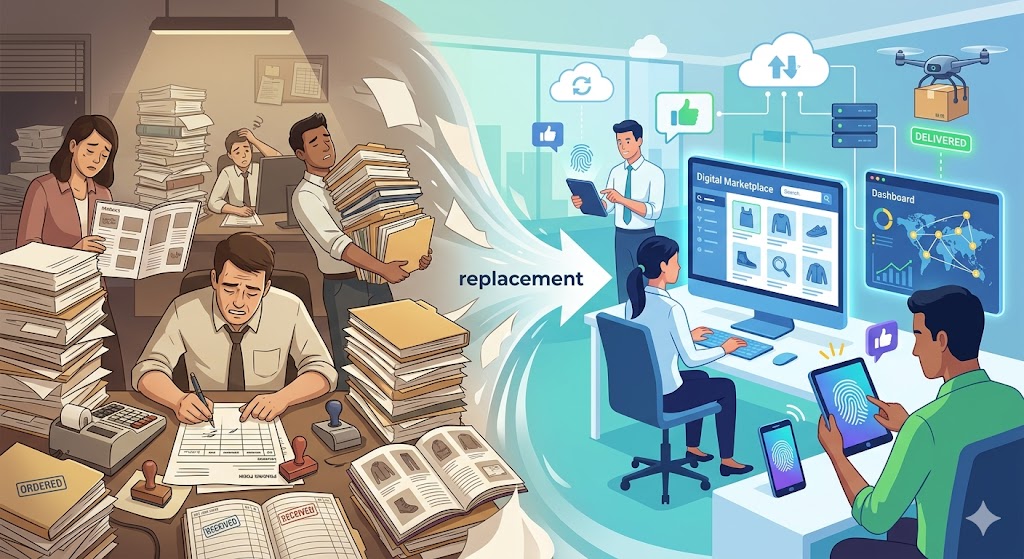
Large enterprises are increasingly centralizing procurement through digital systems. If your business can't connect to procurement platforms, accept electronic purchase orders, or plug into ERP systems, you're simply not in the running for many high-value contracts.
B2B ecommerce isn't just a convenience anymore. It's a procurement requirement.
The Revenue Case Is Undeniable
Companies that invest in B2B ecommerce consistently report:
- Lower cost per order (no manual processing overhead)
- Higher average order values (better product discovery, upsell features)
- Improved customer retention (self-service builds habit and loyalty)
- Expanded market reach (sell 24/7 across time zones without growing headcount)
Key Features of a Successful B2B Ecommerce Store
Not all B2B ecommerce websites are created equal. The difference between a platform that drives serious revenue and one that frustrates buyers comes down to features.
1. Custom and Tiered Pricing
Every B2B relationship involves negotiated pricing. Your platform needs to support:
- Customer-specific price lists (different rates for different accounts)
- Volume-based tiering (buy 100 units, get 15% discount; buy 500, get 22%)
- Contract pricing that locks agreed rates for specific periods
- Hidden public pricing — some B2B businesses don't want competitors seeing their wholesale rates
2. Bulk Ordering and Quick Order Tools
Business buyers often already know exactly what they want. Features like bulk order forms with SKU entry, CSV/spreadsheet upload for large orders, and quick reorder from purchase history dramatically reduce the time it takes to complete a purchase.
3. Quote Request System (RFQ)
Not everything has a fixed price in B2B. A strong B2B ecommerce website needs a request-for-quote (RFQ) module that lets buyers submit a product list and quantity, receive a custom quote, and convert that quote to an order with a single click.
4. Multi-User Accounts with Role-Based Access
A single corporate account might have a buyer who can browse but not check out, a purchasing manager who approves and places orders, an accountant who views invoices, and an admin who manages all users. This kind of role-based structure is critical for selling to mid-size and large businesses.
5. ERP Integration
Without ERP integration, you're running two separate systems that must be manually reconciled — leading to errors, delays, and frustrated customers. A properly integrated B2B ecommerce website will sync with your ERP (SAP, Oracle, NetSuite, Microsoft Dynamics) to automatically update inventory, push orders, sync accounts, and handle invoicing.
6. CRM Integration
CRM integration (Salesforce, HubSpot, Zoho) ensures that every online order triggers the right sales team notifications, customer purchase history is visible alongside sales conversations, and renewal and upsell opportunities aren't missed.
7. Advanced Search and Product Discovery
B2B catalogs are often enormous — thousands of SKUs with technical specifications. Look for faceted search with filters by specification and brand, SKU/part number search, and synonym and error-tolerance.
8. Mobile Optimization
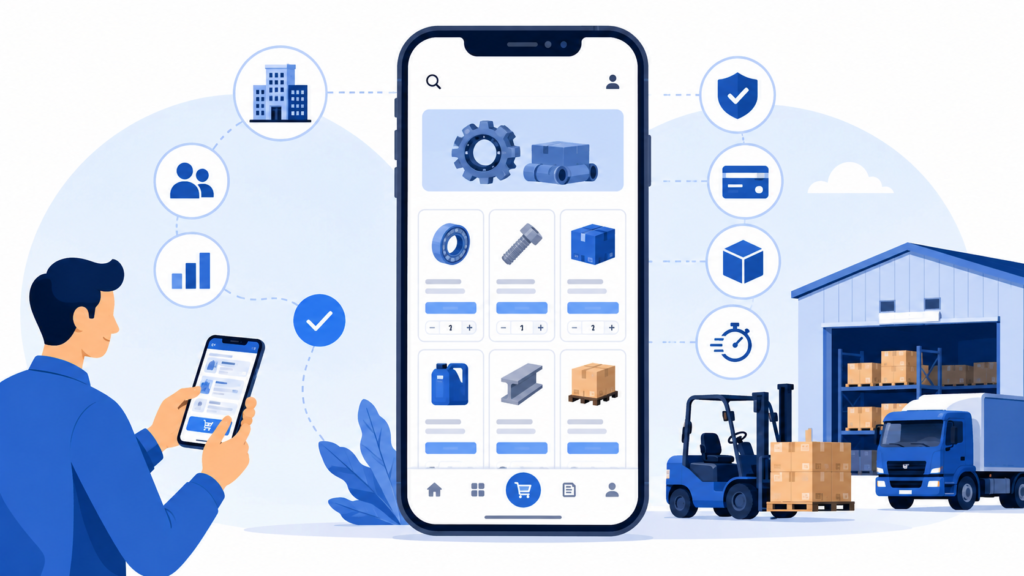
Warehouse managers check inventory from a tablet. Field sales reps are placing emergency orders on their phones. B2B buyers use mobile devices constantly — your B2B ecommerce platform needs to work flawlessly on all of them.
9. Customer Portal and Self-Service Hub
A dedicated B2B customer portal should provide each account with a personalized dashboard that lets them view and reorder past purchases, download invoices and shipping documents, check their account balance and credit limit, submit support tickets or RFQs, and track active orders and shipments.
10. AI-Powered Personalization
Modern B2B ecommerce platforms increasingly use AI to recommend products based on order history, flag items customers frequently buy before they run out, suggest complementary products at checkout, and prioritize search results based on buyer behavior.
11. Flexible Payment and Terms Management
B2B payment is complex. Your platform needs to support net payment terms (Net 30/60/90), purchase order number entry at checkout, credit limit management, multiple payment methods (ACH, wire transfer, corporate card), and invoice generation and payment tracking.
Step-by-Step Process to Build a B2B Ecommerce Website
Building a B2B ecommerce website is not something you rush through. Here's a structured approach that production-grade ecommerce development companies follow.
Step 1: Discovery and Requirements Mapping (Weeks 1–3)
Before writing a single line of code, you need clarity on:
- Who are your buyers, and what does their purchase journey look like?
- What integrations are non-negotiable (ERP, CRM, PIM, 3PL)?
- What pricing models do you operate with?
- Which existing systems need to be replaced or connected?
- What are the compliance or regulatory requirements in your industry?
Skipping the discovery phase is the single biggest reason B2B ecommerce projects go over budget.
Step 2: Platform Selection
Based on your requirements, you'll select a platform. Key factors include the scale of your catalog and order volume, the level of customization required, the budget for development and licensing, and the internal IT capacity to manage the platform.
Step 3: UX Design and Information Architecture
B2B UX is different from B2C. The goal isn't to delight and inspire — it's to make ordering as fast and frictionless as possible. Your design phase should produce a sitemap, customer portal wireframes, checkout flow design, mobile-responsive layouts, and accessibility compliance (WCAG 2.1).
Step 4: Development and Customization
Your ecommerce development company will build the core storefront and product catalog, develop custom pricing logic and account management features, build or configure the RFQ and approval workflow systems, integrate with ERP, CRM, and other backend systems, and develop the B2B customer portal. Depending on complexity, this phase takes 8 to 24 weeks.
Step 5: Data Migration
If you're transitioning from an existing system, you'll need to migrate customer account records, product catalog and pricing data, historical order data, and inventory records. Data migration is notoriously underestimated — build extra time and budget into this phase.
Step 6: Testing and Quality Assurance
A thorough QA process covers functional testing, integration testing, performance testing, security testing, and user acceptance testing with actual buyers.
Step 7: Launch and Change Management
Launch day isn't the end — it's the beginning. A successful go-live includes a phased rollout starting with a subset of customers, training for internal teams and key customer accounts, monitoring dashboards to catch issues in real time, and a clear support and escalation process.
Step 8: Ongoing Optimization
Establish a roadmap for continuous improvement based on customer feedback and support tickets, analytics data (where are buyers dropping off?), sales team input, and platform updates.
Choosing the Right B2B Ecommerce Platform
Platform selection is one of the most consequential decisions you'll make. Here's an honest comparison of the leading options.
| Platform | Best For | B2B Features | Customization | Hosting |
|---|---|---|---|---|
| Shopify Plus | Mid-market, fast growth | Strong native (since 2022) | High (APIs/apps) | SaaS |
| Magento Adobe Commerce | Enterprise, complex catalogs | Excellent native module | Very High (open source) | Self-hosted or cloud |
| BigCommerce B2B Edition | Mid-market, tech-friendly | Good B2B Edition | High | SaaS |
| WooCommerce | Small-mid, budget-conscious | Plugin-dependent | Very High | Self-hosted |
| Salesforce Commerce Cloud | Enterprise, omnichannel | Enterprise-grade | High | SaaS |
Shopify Plus for B2B
Shopify dramatically expanded its B2B capabilities in 2022. The platform now offers native support for company accounts, custom price lists, net payment terms, and B2B-only storefronts.
Strengths: Fast to launch, excellent UI/UX, massive app ecosystem, strong headless commerce support.
Limitations: Less suitable for deeply complex manufacturing catalogs or heavy ERP customization.Best for: Wholesale brands, distributors, B2B startups scaling quickly.
Magento Adobe Commerce (B2B)
Magento is the platform that many experienced ecommerce development companies recommend for complex B2B requirements. Its native B2B module includes shared catalogs, company accounts, RFQ, requisition lists, and purchase order management.
Strengths: Extremely flexible, powerful B2B module, ideal for large, complex catalogs, strong multistore capabilities.
Limitations: Higher total cost of ownership, requires skilled Magento developers, and longer development timelines.
Best for: Manufacturers, large distributors, enterprises with complex catalog and pricing needs.
BigCommerce B2B Edition
BigCommerce has invested significantly in B2B with its dedicated B2B Edition, offering features like customer-specific pricing, invoice management, and a buyer portal out of the box.
Strengths: Good balance of SaaS simplicity and B2B capability, open API architecture, competitive pricing.
Limitations: Smaller development community than Shopify or Magento.
Custom vs SaaS B2B Ecommerce Development
SaaS Platforms (Shopify Plus, BigCommerce, etc.)
Advantages:
- Faster time to market (weeks vs months)
- Lower upfront development cost
- Platform handles security, hosting, and core updates
- Built-in features that cover 70–80% of typical B2B needs
Disadvantages:
- Monthly licensing fees add up over time
- Less flexibility for genuinely unique workflows
Custom B2B Ecommerce Development
Advantages:
- Complete control over features and functionality
- No licensing fees (you own the code)
- Built exactly around your unique workflows
Disadvantages:
- Significantly higher upfront development cost
- Longer build timeline
- You're responsible for all maintenance and security updates
The Hybrid Approach
Many experienced ecommerce development companies recommend a hybrid approach: use a flexible platform like Magento or BigCommerce as the foundation, then build custom extensions, integrations, and workflows on top. This gives you the best of both worlds — a battle-tested core with tailor-made functionality where it matters.
Common Challenges in B2B Ecommerce Development
Challenge 1: Complex Pricing Logic
The Problem: B2B pricing involves customer-specific rates, volume tiers, promotional pricing, and contract terms that must coexist without conflict.
The Solution: Map every pricing rule before development begins. Use a platform with a robust pricing engine. Work with a development partner who has built B2B pricing systems before.
Challenge 2: ERP Integration Failures
The Problem: Inventory goes out of sync, orders get stuck in limbo, and customer accounts don't accurately reflect credit limits.
The Solution: Insist on a proper API-based integration with clear field mapping, error handling, and real-time sync where it matters. Test this relentlessly before launch.
Challenge 3: Customer Adoption Resistance
The Problem: Long-standing customers are comfortable calling their rep or faxing a PO. They don't want to change.
The Solution: Involve your key customers in the design process. Offer training and onboarding. Give sales reps commission credit for digital orders. Highlight the self-service benefits.
Challenge 4: Performance at Scale
The Problem: Your catalog has 50,000 SKUs. Your largest customer places 500-line orders. The site crawls.
The Solution: Performance must be baked into the architecture from day one — not bolted on later. This includes database optimization, CDN configuration, caching strategy, and load testing before launch.
Challenge 5: Mobile Experience for Field Teams
The Problem: Your B2B portal looks great on desktop but is virtually unusable on mobile.
The Solution: Design mobile-first, not as an afterthought. B2B mobile usage is rising fast, especially for reorders and order status checks.
B2B Ecommerce SEO Best Practices
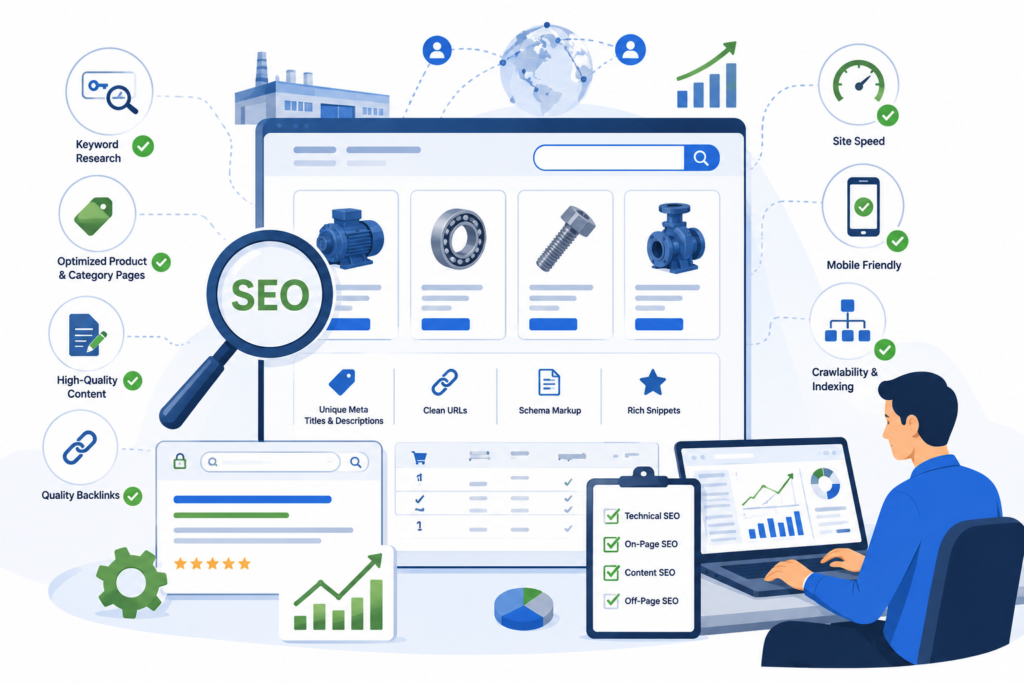
Technical SEO Foundations
Before worrying about content, get the technical fundamentals right:
- Site speed: Google PageSpeed score above 70 on mobile is the baseline.
- Crawlability: Ensure search engines can access and index all important product and category pages.
- HTTPS and security: Non-negotiable. Every page should be served over HTTPS.
- Mobile usability: Run Google's Mobile-Friendly Test on key pages.
- Core Web Vitals: LCP, FID, and CLS — all measured by Google in rankings.
Category Page Optimization
Category pages are often the highest-traffic pages on a B2B ecommerce site. Treat them as landing pages: write unique keyword-rich descriptions (200–400 words), use descriptive H1 tags, add breadcrumb navigation with schema markup, and include filters that create indexable faceted URLs.
Long-Tail Keyword Strategy
B2B buyers search with a very specific intent. 'Industrial conveyor belt suppliers' or 'custom aluminum extrusion wholesale minimum order' are far easier to rank for than generic terms — and they convert much better because the buyer's intent is clear. Build content around these long-tail terms through product-specific landing pages, application guides, use case content, and FAQ pages structured around common buyer questions.
Schema Markup for B2B
Implement the Product schema on all product pages, the Organization schema on your homepage, the FAQPage schema for FAQ content, the BreadcrumbList schema for navigation, and the HowTo schema for process-based content.
How to Choose the Right Ecommerce Development Company
Your platform choice matters. But your development partner matters just as much — maybe more. Here's what to look for.
1. Genuine B2B Experience, Not Just Ecommerce Experience
Ask to see specific B2B examples in their portfolio. Look for projects involving custom pricing systems, ERP integrations, multi-account management, and RFQ and order approval workflows.
2. Deep Integration Expertise
The right ecommerce development company should have demonstrable experience integrating with your specific ERP system (SAP, Oracle, NetSuite, Microsoft Dynamics), CRM platforms (Salesforce, HubSpot), inventory management and WMS systems, and payment gateways that support B2B terms.
3. A Structured Discovery Process
Be very wary of any development company that gives you a fixed quote without a thorough discovery phase. Complex B2B projects have too many variables to estimate accurately without a deep understanding of your requirements.
4. Scalability Planning
Ask your potential development partner: How will the platform handle 10x your current order volume? What's the path from 5,000 SKUs to 50,000? How do we handle international expansion or multi-currency?
5. Post-Launch Support Model
Understand exactly what post-launch support looks like: Do they offer a retainer for ongoing development? What's their response time for critical bugs? Do they provide performance monitoring?
6. Transparent Communication and Process
A reliable ecommerce development company will have a clear project management process — regular updates, defined milestones, and a single point of contact who actually knows your project.
Future Trends in B2B Ecommerce
The businesses that win in B2B ecommerce over the next five years will be the ones investing today in the technologies and capabilities that are just beginning to mature.
AI and Machine Learning
AI is moving beyond basic product recommendations. The next wave includes AI-driven demand forecasting, dynamic pricing engines that adjust B2B pricing based on market conditions, natural language search, and automated quote generation for complex, configurable products.
Headless Commerce Architecture
Headless commerce separates the front-end presentation layer from the back-end commerce engine, allowing businesses to deliver buying experiences through any channel — website, mobile app, IoT device, voice interface — using a single back-end.
Automation and Workflow Orchestration
B2B commerce involves a huge number of repetitive workflows — order acknowledgments, credit checks, shipping notifications, and reorder reminders. Automation platforms are increasingly connecting these workflows without human intervention.
Voice Commerce and Conversational Ordering
Already tested in warehouse environments, voice-activated ordering lets procurement staff place reorders hands-free using smart speakers or voice-enabled devices. Niche today, mainstream within five years.
AR/VR for Complex Products
For industries such as manufacturing equipment, construction materials, or industrial components, augmented reality enables buyers to visualize products in their own environment before purchase — particularly powerful for reducing returns on high-value orders.
Predictive Analytics and Business Intelligence
The most sophisticated B2B ecommerce platforms are beginning to offer buyers real-time analytics about their own purchasing behavior — spend patterns, category trends, and budget tracking against purchase history. This kind of value-added intelligence deepens customer loyalty.
Conclusion
B2B ecommerce development is not a simple website project. It's a strategic digital transformation initiative that — when done right — fundamentally changes how your business acquires, serves, and retains customers.
The businesses that are winning in this space share a few things in common: they invested time in proper discovery and planning, they chose a platform that matched their actual requirements, they built the right integrations from day one, and they partnered with an experienced ecommerce development company that understood B2B's unique complexity.
The $3 trillion B2B ecommerce market isn't waiting for anyone to catch up. Your buyers have already decided they want digital self-service. The question is whether they'll find it with you — or with someone else.
If you're ready to start that conversation seriously, the next step is a proper discovery engagement with a development partner who has built B2B ecommerce solutions before. Not a quote call. A real discovery process that maps your requirements, your integrations, and your commercial goals to a platform and architecture that can actually deliver.
That's where transformative B2B ecommerce projects begin.
Frequently Asked Questions (FAQ)
What is B2B ecommerce development?
B2B ecommerce development is the process of building an online store or digital ordering system designed specifically for business-to-business transactions. Unlike consumer-facing stores, B2B ecommerce platforms support features such as custom pricing, bulk ordering, multi-user accounts, ERP integration, and purchase-order-based payment — all tailored to how businesses actually buy from each other.
How is B2B ecommerce different from B2C ecommerce?
B2B ecommerce involves selling to businesses rather than individual consumers. Key differences include: complex, negotiated pricing rather than fixed retail prices; large bulk orders rather than single items; multi-user company accounts with role-based permissions; payment via net terms or purchase orders rather than immediate checkout; and mandatory integration with enterprise systems such as ERPs and CRMs.
How long does it take to build a B2B ecommerce website?
The timeline depends heavily on complexity. A straightforward B2B store on Shopify Plus with standard features can launch in 8–12 weeks. A complex enterprise built on Magento with deep ERP integration, custom workflows, and large catalog migration typically takes 4–9 months. Discovery, data migration, and testing often take longer than expected — so build a buffer into your timeline.
How much does B2B ecommerce development cost?
Cost varies significantly based on platform choice, feature complexity, and integration requirements. A mid-market B2B store on Shopify Plus typically runs $25,000–$75,000 in development costs. A custom enterprise solution built on Magento Adobe Commerce, with full ERP integration and complex pricing logic, can range from $100,000 to $500,000+. Ongoing platform licensing, hosting, and support costs are separate.
What is the best B2B ecommerce platform?
There's no single best platform — the right choice depends on your requirements. Shopify Plus is excellent for mid-market B2B businesses that need to launch quickly with a modern UX. Magento Adobe Commerce is the strongest choice for complex enterprise requirements with deep customization needs. BigCommerce B2B Edition offers a solid middle ground. A good ecommerce development company will recommend the right platform after understanding your specific needs.
